
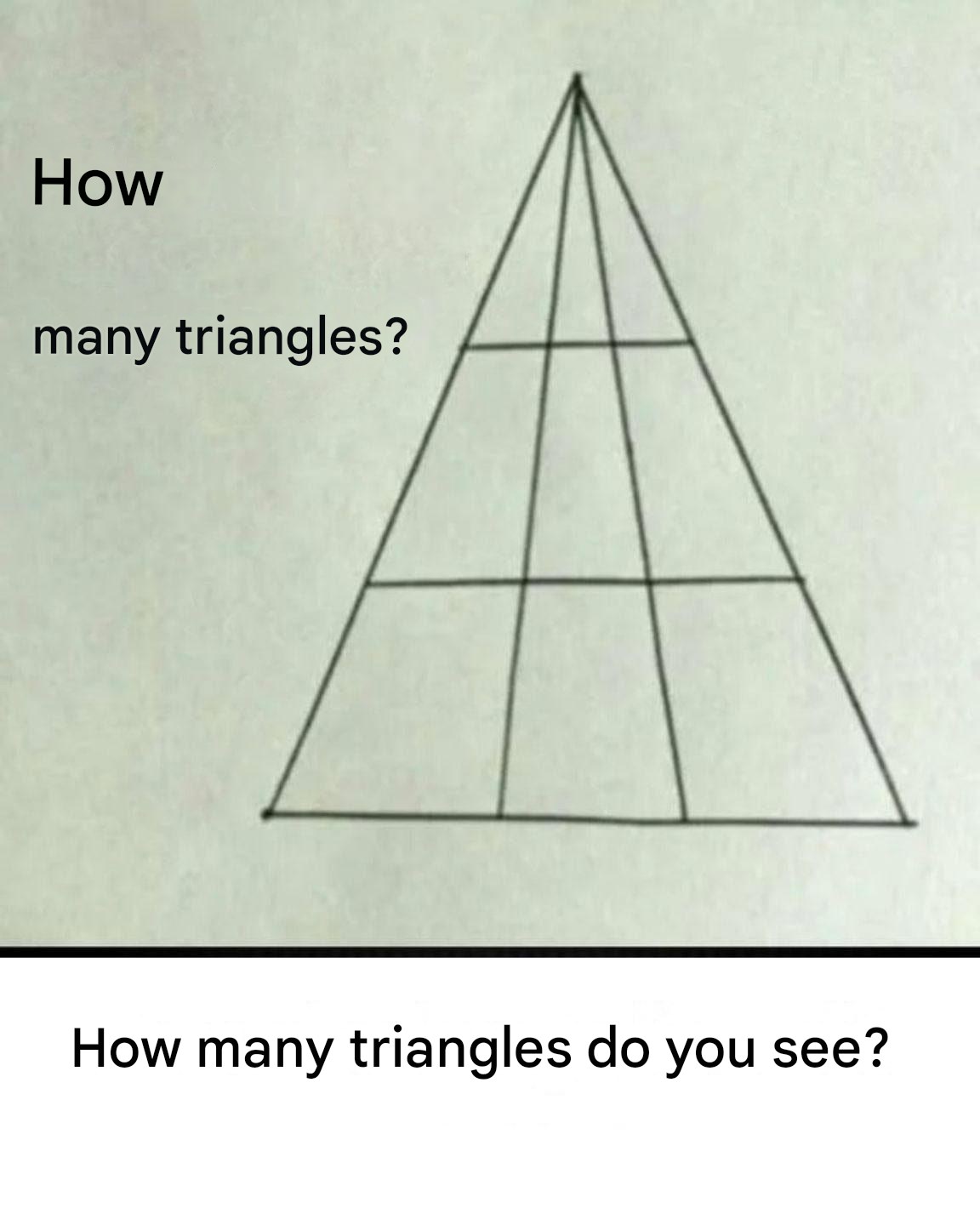
How many triangles do you see in this picture?
You thought you had found the right answer, but… this famous puzzle has fooled even experienced eyes! At first glance, we only count a few triangles, and then as we progress through the “levels,” we count more and more. Simple? Not really.
The figure – a large triangle divided by three lines parallel to its base – hides more shapes than we think. Are you ready to avoid the trap and shine on the next quiz? Follow the guide!
The Trap of Hidden Triangles
Our brains easily notice small, obvious triangles… but tend to forget the larger ones, which are formed by combining several parts. Because of this, we often underestimate their number.
In the classic layout (4 rows, with 3 lines parallel to the base), the correct answer is 27.
If you guessed 26, you probably missed a large, complex triangle – for example, a 3-level, upward-pointing triangle, or a wider, lateral triangle.
Step-by-step method: how to count flawlessly
Upward-pointing triangles:
1 level high: 10
2 levels high: 6
3 levels high: 3
4 levels high: 1
Subtotal:
10 + 6 + 3 + 1 = 20
Downward-pointing triangles:
The intersection of the lines creates 7 more.
Total:
20 + 7 = 27
👉 Memorization trick: “20 up + 7 down”
The magic formula is simply
Would you like a more elegant abbreviation?
If we divide a large triangle into n rows (with lines parallel to the base), we can use the following formula:
T(n) = n × (n + 2) × (2n + 1) ÷ 8
Applied to n = 4:
T = 4 × 6 × 9 ÷ 8 = 27
This formula automatically counts all possible triangle sizes, even complex shapes. Perfect for a quick check or to end a discussion!
Common mistakes (and how to avoid them)
You only count “levels” and leave out large triangles
You forget about downward-pointing triangles (there are 7 of them)
You add imaginary plus lines (which change the result)
You double-count some triangles
Go logically by size, so you can avoid repetitions.
Want to practice more?
Change the number of rows (n = 3 or n = 5) and try the formula
Time yourself: can you get to 27 in 60 seconds?
Explain it to a friend – teaching helps with long-term memory
Because behind a simple triangle there is often a little logic lesson hidden… and the joy of being right in the end! 😊
